Wednesday, September 16, 2026
Why Bother Compiling an MCP Server When You Already Have a Web Chatbot and CLI?

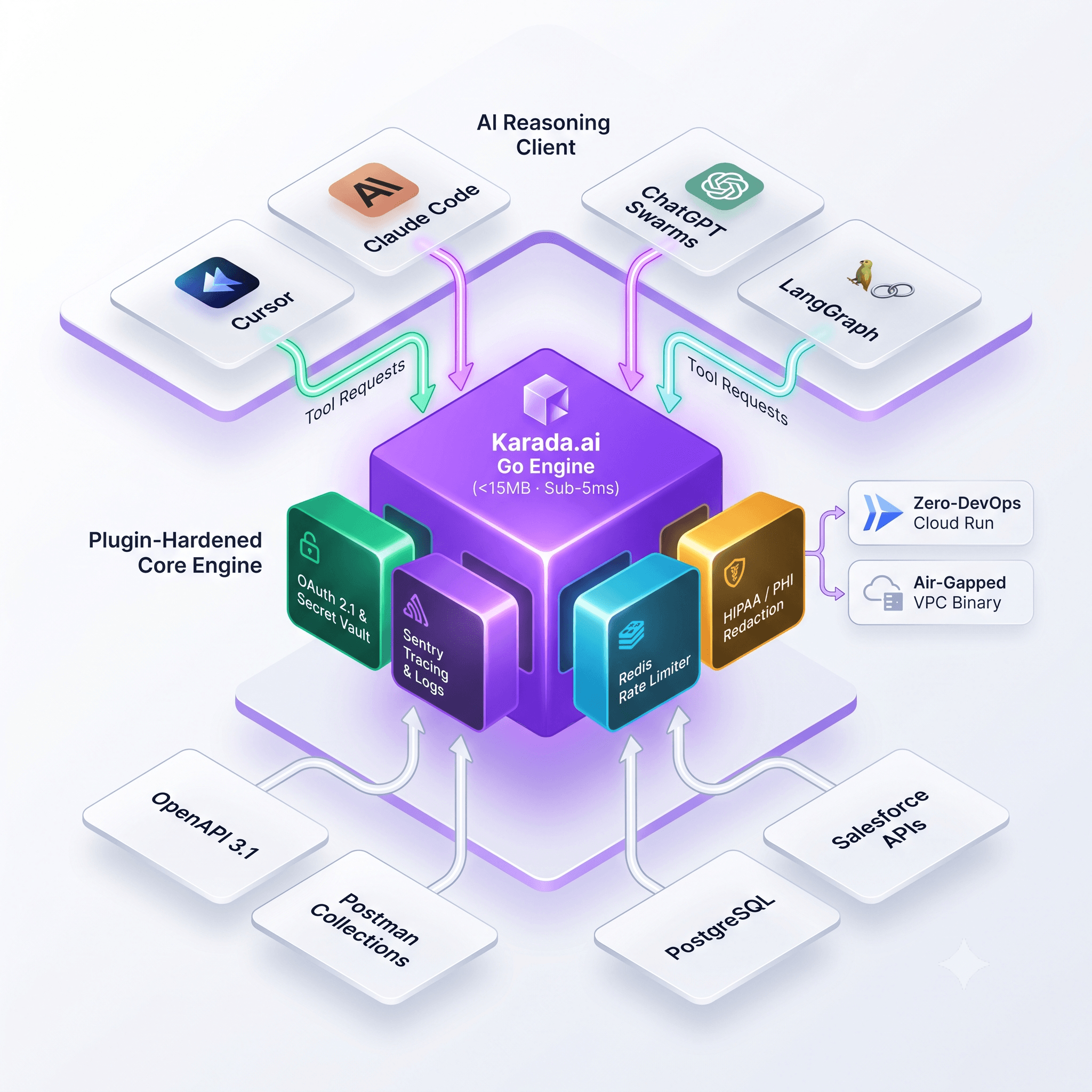
"Why bother compiling an MCP server when we already have an in-app web chatbot and a custom CLI tool for developers?"
I was chatting with an AI founder recently who asked a fair architectural question. It captures the #1 debate across AI agent infrastructure today: How should modern software expose its business capabilities to autonomous agents?
Many engineering teams assume that their existing developer interfaces—an embedded web chatbot UI or a custom CLI utility—are sufficient for the AI era. But in production environments, both paradigms hit severe structural bottlenecks. Here is why in-app chat and CLIs break down in production, and where machine-native protocols like the Model Context Protocol (MCP) take over.
1. The In-App Chat Bottleneck (vs. MCP)
In-app chatbots force your company into managing model inference, provider rate limits, context windows, and messy token billing. You end up packaging costly pay-as-you-go credit bundles and bearing the infrastructure margin risk when users query large models.
With MCP, the paradigm flips: customers bring their own models & API keys (BYOK) directly inside their native working environments—such as Cursor, Claude Code, Windsurf, or internal enterprise agent swarms. You monetize your platform and proprietary data ontology without bearing LLM compute costs.
Moreover, in-app chatbots trap interactions inside a browser tab. An MCP server lets users and background agent cron jobs invoke your tools programmatically 24/7 without requiring human eyes on a web screen.
2. CLIs are Built for Humans, Not LLMs (vs. MCP)
Developer CLIs are optimized for human eyes: verbose help flags, terminal color formatting (ANSI escape codes), interactive prompts, and unstructured ASCII tables. When an LLM ingests this output, fuzzy text scraping burns through token budgets and causes parameter hallucinations.
Even worse: enterprise security teams forbid granting agents arbitrary shell execution privileges (bash -c ...). Unrestricted terminal execution is an unacceptable security vulnerability in enterprise fleets.
MCP (standardized under the Linux Foundation / AAIF) is purpose-built for AI: providing typed JSON schemas, deterministic parameter validation, and zero-trust authorization boundaries for every tool call.
3. The Composable Middleware Layer
With custom scripts or CLIs, developers have to hand-code security, token injection, rate-limiting, and observability for every single tool from scratch.
With a dedicated sub-5ms Go engine in Karada, you drop in production plugins at compile-time:
- Structured Observability: Real-time JSON-RPC logging, latency tracking, and compliance audit trails across every tool execution.
- Zero-Trust Secret Vaults: Injects OAuth/API tokens server-side so LLMs never touch or leak raw client credentials.
- Enterprise Guardrails: Rate-limiting, prompt-injection firewalls, and request validation out of the box.
The Bottom Line
Your application and data ontology are the business Brain—the storage, domain models, and business logic.
MCP provides the standardized, compiled Body through which AI models act on real-world software.
Are your users demanding in-app web chat, CLI scripts, or ambient MCP tools in their IDEs? Auto-compiling your OpenAPI specs into Go MCP servers bridges that divide on day one.